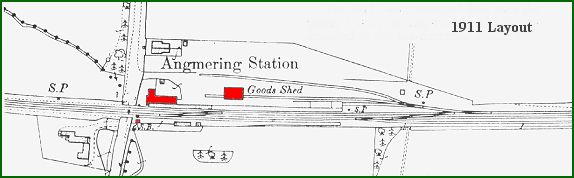
|
Railway Station, Angmering |
Angmering Station was opened on 16 March 1846 when the London, Brighton & South Coast railway line was extended from Worthing to Ford Junction.
Until that time travel to London could only be accomplished by the turnpike road via Long Furlong to Findon and then to the north. The railway was to have a significant effect on Angmering for the next 100 years.
Angmering's soil had always been fertile and ideal for the development of crops for the domestic market. With burgeoning seaside resorts on the coast, a demand arose for fresh food as did a similar demand from the London and Midlands markets. A market gardening industry was therefore born, the principal crops being tomatoes and flowers. In 1854, a goods yard at the station was established on a large piece of land to the north of the line - this was given to the Railway Company by the Squire of Ham Manor, William Gratwicke Kinleside Gratwicke. A loading shelter was later built to the east of the engine shed, the latter still standing today. Produce was sent daily to London where some was transferrd to trains serving the Midlands area.
The original station did not last long and was replaced by a new one in the 1860s which remains to this day. The signal box on the south side of the station adjacent to the level crossing was constructed in 1877 and remained until the early 1990s when the need for it ended with the establishment of a centralised and computerised signalling system. The wooden waiting room on the south platform was also demolished c1990. The footbridge between the north and south platforms was erected in the 1930s.
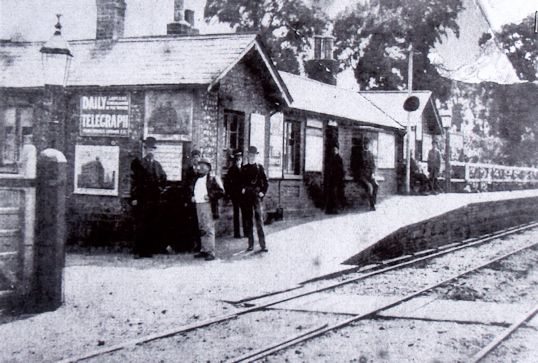
1st
Angmering Station c1860 prior to demolition
In 1853 there were five trains to Brighton or London on weekdays and three on Sundays. Until 1879, when the Hove to Preston Park loop was opened, all passengers needed to go into Brighton station and change trains if they wished to go on to London. The journey time from Angmering to London (via Brighton) was a little over 2½ hours, a fraction of what it had been when coach travel was all that had previously existed. In 1853 the first class fare to London 13s. 6d, 2nd Class - 10s. 3d, and third class - 6s. 9d. As passenger traffic increased, the fares were later reduced, a third class fare to London costing about 5s. 0d., and 7½d. to Worthing.
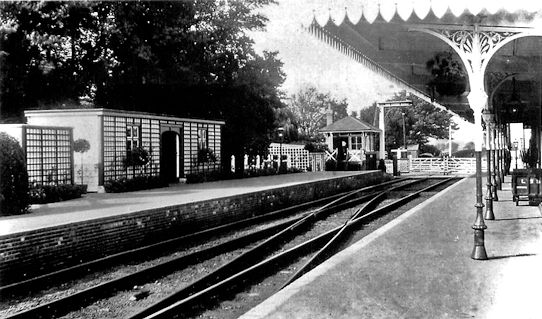
2nd
Angmering Station - built in 1860s
(Photo: courtesy Richard
Standing)
By the early 20th Century, commuter traffic between the South Coast and London was evident. The annual season ticket fares between Angmering and London in 1916 were: 1st Class £43 15s; 3d Class, £28 10s.
But in its earlier days, Angmering station was not just a railway station; the station master also served as the local postmaster. From here mail for Angmering, East Preston, Kingston and Rustington was sorted and distributed.
There is no indication that Angmering station was managed by a station master in the early years and perhaps it was under the supervision of a clerk. In 1851, the station clerk was Henry Wills from Chichester but by 1861 he had been replaced by John Grover from Newick. Certainly, by 1855, Angmering had a station master - Mr GF Oakley - who retired in December 1858 after three years in that appointment. In 1871, George Searle was the clerk and the census records tell us between 1881 and 1891 he was designated "station master". Searle was baptised in Broadwater in 1831 although he claimed in the 1881 Census to have been born in Clapham village. Sometime after 1891, Searle was replaced by Walter J. Judges who originated from Tumbridge Wells.
In 1901, Horace Hayward, from a Littlehampton family, was appointed to the position which he held until 1930, retiring after 50 years service with the railway. Horace also served as the postmaster at the station until the sub post office and sorting office there closed during his tenure. Arthur Charles Tickner was the stationmaster between 1936 and 1949.
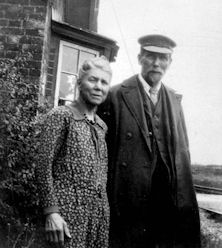 |
|||
| Mr Howick, Roundstone Crossing keeper, with wife, 1924 (Photo: courtesy Clive Horton) |
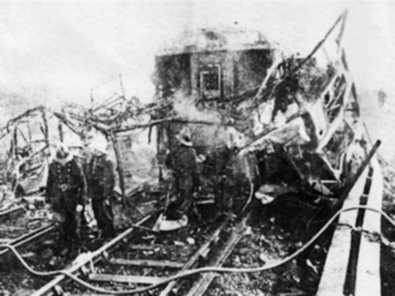
The first accident on this stretch of railway appears to have occurred in the Angmering area when the guard on a train hit his head on a bridge - he appears to have been checking luggage on the roof of the train which was carried in a similar way to stage-coaches. Over a hundred years elapsed before the next serious accident in the Angmering area. This was on 22 September 1965 when the 8.47am Brighton to Portsmouth train hit a Southdown double decker bus at 9.31am in thick fog at the Roundstone crossing (see photo below). The bus and the front end of the train were burnt out and three women on the bus were killed and another eight injured. The official report dated 20 December 1965 largely blamed crossing keeper, C A Coleman, for an error in opening the wheel operated gates to road traffic as he had made an incorrect assumption that the train had already passed the crossing. However, the report also stated that the signalling equipment was obsolete and the accident would not have happened if the latest automatic crossing barriers had been installed.
A local woman, Maureen Weselby, committed suicide by jumping in front of a Brighton-bound express, operated by South West Trains, in May 2006. A local teenager, Adam Blackwood, was killed about 400 metres east of the station when a Littlehampton-bound Southern Class 377 train approaching the station knocked him down at a nearby pedestrian rail crossing on New Year's Day 2007. Another local, 16-year-old Megan Moore, was accidentally killed after being dragged under the 22:17 London Victoria to Bognor Regis train just before midnight in November 2009.
The annual estimated passenger usage of Angmering Station, based on sales of tickets which end or originate at Angmering, rose from 366,334 in 1997-98 to 883,150 in 2013-14 (source: Office of Rail Regulation)
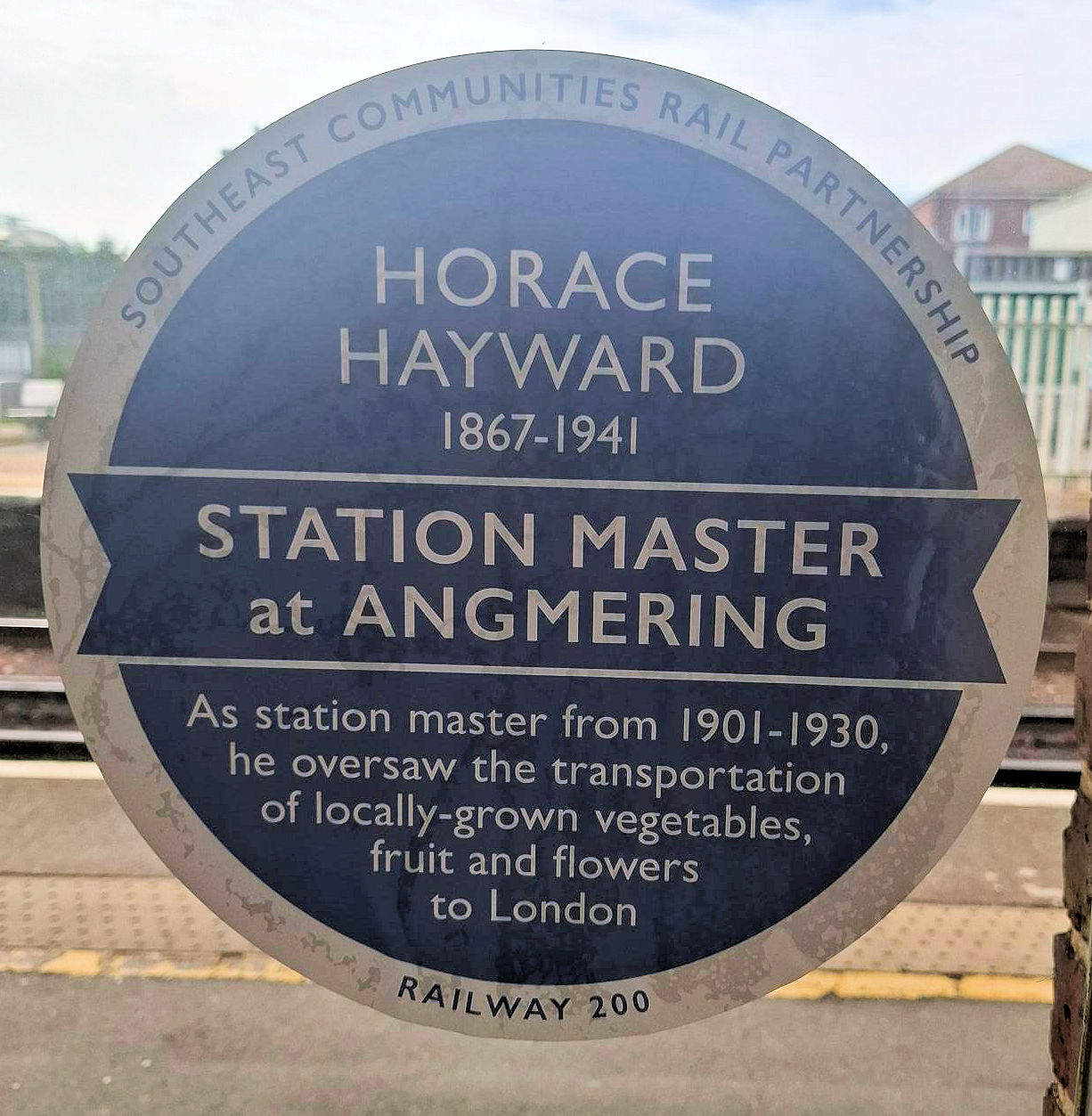
In June 2025, as part of the National Rail 200th year celebrations, a temporarry 'blue plaque' (see below) was affixed to the window of Angmering station, recording the service of Horace Hayward, station master between 1901 and 1930. This was one of 200 ‘blue plaques’ produced by the Southeast Communities Rail Partnership to celebrate 200 people connected to its railway lines
 ...
...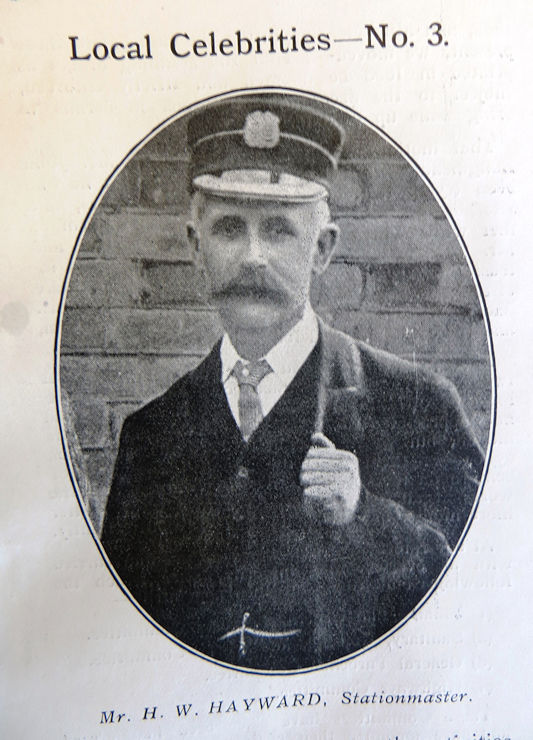
To provide some insight into the life and railway service of Horace Hayward, the local WW1 newsheet "Scribble" published the following article in July 1919:
Mr. H.W. Hayward, Stationmaster
For close on twenty years the activities at Angmering railway Station have been under the capable direction of Mr. H.W. Hayward, and right well does he perform his multifarious duties. The number and extent of those functions would probably surprise the average railway traveller, who has a sub-conscious idea that a station master's chief work is to receive and despatch passengers with a pleasant smile and to spend the time between trains as his fancy directs. Mr. Hayward is inherently modest and cannot be persuaded to talk about himself, but a little research has led us to discover that he has a really fine record in the service of the London, Brighton and South Coast Railway Company. From the time he entered the service, a bashful and timid youth, in 1880, to the time of mounting the three gorgeous gold bands that now adorn his uniform cap, a period of 39 years, not once has he been absent from duty through sickness. There is a record of which he may well be proud, though, no doubt, most of the credit is due to the solicitous care bestowed upon him by his charming "better half." Since 1880 he has put in service as clerk at Ford Junction, Worthing, Midhurst, and Littlehampton. He first became Station-master in 1893 at Bishopstone. Two years later he was transferred to Barcombe, where he spent three years, after migrating to Baynards, from whence after three years, he directed his course to Angmering. In addition to his railway duties, he has 23 years postal service to his credit, having served under the postmasters of Lewes, Horsham, and Worthing. It is, perhaps, inevitable that the interests of railway companies and those of the general public should, at times, clash, but so far as our experience goes, the work at Angmering is carried on with a minimum of friction. "Orace" as he is called on the other side of the fence, has the saving grace of humour and takes an optimistic view of most things, so the wheels of business run very smoothly. Even the person who habitually takes a jaundiced view feels all the better for coming in contact with him. Mr Hayward takes a great interest in the work of St. John's Ambulance Association, and has passed through several courses of instruction with distinction. On more than one occasion he has found his special knowledge very serviceable.
Last updated: 22 June
2025